Last updated: November 2026
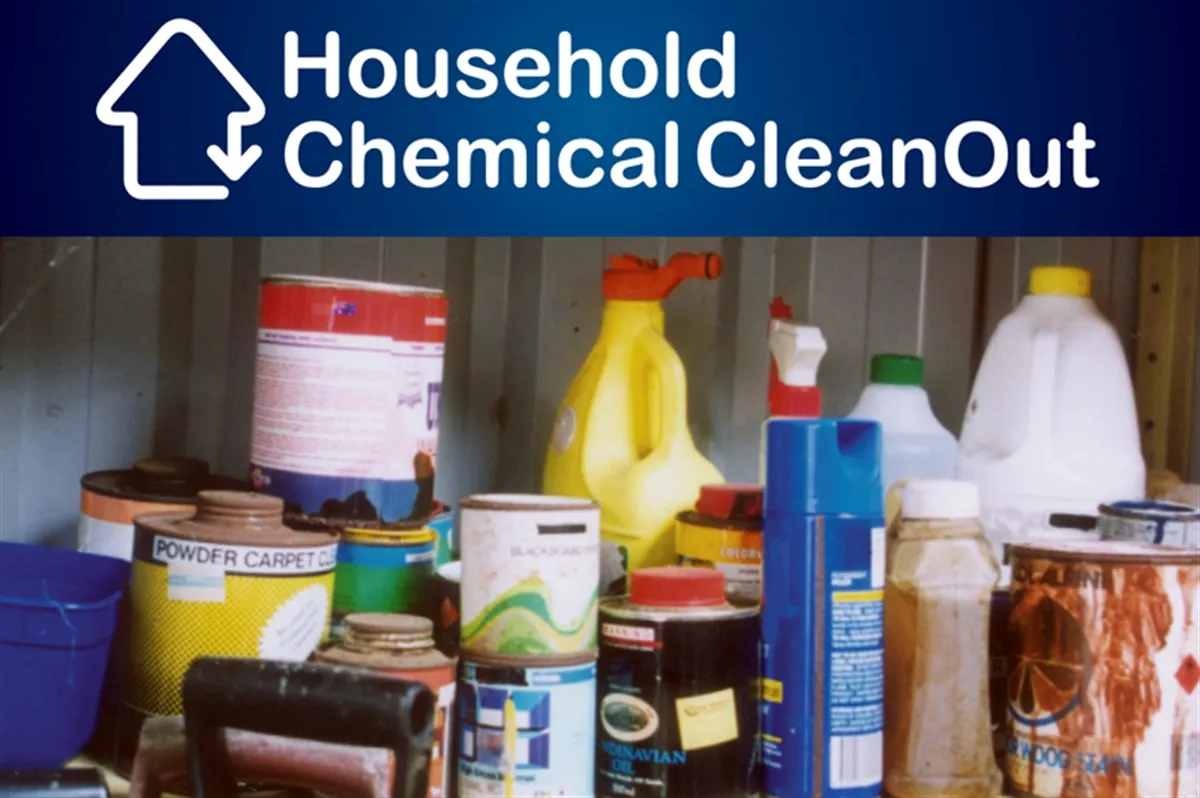
A Household Chemical CleanOut is a free NSW EPA drive-thru for the safe disposal of paint, pool chemicals, pesticides, batteries, gas bottles and other household products, up to 20 litres or 20 kilograms per item. If there's no event coming up near you, a Community Recycling Centre takes the most common ones all year.
None of these hazardous materials belongs in your household bins. Penrith Council lists the risks of getting it wrong: contaminated ground and surface water, harmed wildlife, injured garbage collectors and more dangerous house fires. The EPA files them under household problem waste, which has to be taken somewhere rather than left out for the council. In practice, hazardous waste disposal in Sydney comes down to two free options and a few take-back schemes for particular items.
Hazardous waste disposal in Sydney: where each item goes
Find your item on the left. The right column is where it goes.
| What you've got | Where it can go | |---|---| | Pool chemicals, pesticides, herbicides and poisons | A CleanOut event | | Solvents and household cleaners | A CleanOut event | | Hobby chemicals, ammonia-based cleaners and floor care products | A CleanOut event | | Petrol and other motor fuels | A CleanOut event | | Cooking oil | A CleanOut event | | Paint | A CleanOut event, a Community Recycling Centre or a Paintback site | | Motor oil | A CleanOut event or a Community Recycling Centre | | Gas bottles and fire extinguishers | A CleanOut event or a Community Recycling Centre | | Smoke detectors, fluoro tubes and globes | A CleanOut event or a Community Recycling Centre | | Car batteries | A CleanOut event, a Community Recycling Centre, or an automotive or battery shop | | AA, AAA, button and other loose batteries | Supermarkets, hardware stores, a Community Recycling Centre or a CleanOut event | | Unwanted medicines | Your local pharmacy | | Mobile phones and chargers | A MobileMuster collection point | | TVs, computers and printers | An e-waste collection |
The first four rows are where people get stuck. Garden sprays, cleaners and pool products aren't on a Community Recycling Centre's standard list, so a CleanOut is the free way to get rid of them. Some centres do take extra items. Ring first, though, because the EPA says a centre may charge for anything outside its usual list.
Household hazardous waste in NSW: the figures
- More than 100 Community Recycling Centres are open in NSW. Source: NSW EPA, 2025.
- 34 of those centres also collect products with built-in batteries. Source: NSW EPA, 2026.
- 17 councils host a CleanOut on the NSW EPA's Sydney program for July to December 2026, across 21 event days, because four councils run theirs over a full weekend. Source: NSW EPA Sydney brochure, 2026.
- Paintback has collected and treated over 75 million kilograms of unwanted paint and packaging since 2016. Source: Paintback, 2026.
- Paintback has over 165 free collection locations around Australia, each taking up to 100 litres per visit. Source: Paintback, 2026.
What a Household Chemical CleanOut accepts
The EPA's list for its events is:
- Acids and alkalis
- Ammonia-based cleaners
- Car and household batteries
- Fire extinguishers
- Floor care products
- Fluorescent globes and tubes
- Gas bottles
- Hobby chemicals
- Motor fuels
- Motor oils and cooking oils
- Paint and paint-related products
- Pesticides and herbicides
- Poisons
- Pool chemicals
- Smoke detectors
- Solvents and household cleaners
- Vapes
Paint gets a bigger allowance at certain events, up to 100 litres as long as it's packed in 20-litre containers, and the EPA asks you to check that limit with your council first. Vapes are on it too. They hold residual chemicals as well as an embedded battery.
Host councils can take a little more than the EPA list. City of Sydney's own event also accepts printer ink and toner cartridges, nail polish and remover, and nitrous oxide canisters.
And what doesn't go? Ordinary household items. City of Sydney spells it out for its event as electronics, textiles, furniture, whitegoods and metals, along with any business or commercial quantity.
How to find the next CleanOut event in Sydney
The EPA publishes CleanOut dates in regional brochures, and the current Sydney one covers July to December 2026. Events run from 9am to 3:30pm on each listed date.
The quickest way to the dates is epa.nsw.gov.au/cleanout, the EPA's finder for both CleanOut events and Community Recycling Centres. Prefer to ask someone? Call the NSW Environment Line on 131 555.
You don't have to live in the council area that's hosting. Events in Sydney, the Illawarra and the Hunter are open to every NSW resident unless the listing says otherwise, so if you've missed your own council's date you can simply use the next one.
Packing for a CleanOut
- Sort the load against the table above first. Anything a Community Recycling Centre or a shop will take doesn't need to wait for an event.
- Keep each product in its original bottle or tin if you can, with the lid sealed and the label readable. Lost track of what's in a bottle? Write "unknown chemical" on it.
- Resist tipping half-empty bottles together to save room, because mixed chemicals can react dangerously.
- Plan for a leak. Newspaper goes around each bottle of liquid, then a sturdy plastic bag, then a bucket or tray underneath.
- Put tape over battery terminals. If a battery is leaking or corroded, wear gloves and seal it in a plastic bag.
- Pack everything into the boot or the back of the car before you set off, well away from passengers.
- When you get there, stay in the car. Staff unload it for you, and you won't get the bottles back.
Community Recycling Centres, open all year
A Community Recycling Centre is a permanent drop-off point, so it suits anyone whose leftover tins or gas bottles can't wait months for the next event. Councils and other organisations run them in partnership with the EPA.
Almost anyone in NSW can use any centre. The EPA names two exceptions, Leichhardt and Cumberland, where you do need to be a local. Residents of Cumberland and Blacktown can also book a mobile recycling service through problemwaste.com.au.
The centres that take built-in batteries cover things like electric toothbrushes, Bluetooth speakers, power banks and e-scooters. In Sydney that includes Northern Sydney, Leichhardt, Randwick, Liverpool, Campbelltown and Hawkesbury. Hours vary between centres. Ring ahead to check.
Where it all ends up
The EPA says most of what centres collect can be reused or recycled. This is where the main streams end up.
- Paint is mixed with other waste solvents and burnt as an alternative fuel in cement kilns, and the metal tins are recycled.
- Lead-acid batteries are sent to recyclers, and the lead and plastic are recovered.
- Fluorescent lights contain mercury. Recyclers crush them, capture the mercury and separate it by distillation so it can be sold for industrial use.
- Gas bottles have their residual gas captured for reuse. Sound bottles are retested, restamped and go back into the hire industry, and damaged ones are punctured and recycled as scrap metal.
- Used oil is processed into lubricant or used for waste-to-energy.
Clearing out the garage or shed at the same time?
A CleanOut is free, but it runs on set dates and won't take the furniture or whitegoods. If you'd rather clear the lot in one go, we handle hazardous waste too, along with the old furniture, broken whitegoods and general rubbish from the rest of the garage or shed. If you book before midday, Paul can usually collect the same day. See household rubbish removal or garage clean-outs, or call 0407 125 125.