

Last updated: September 2026.
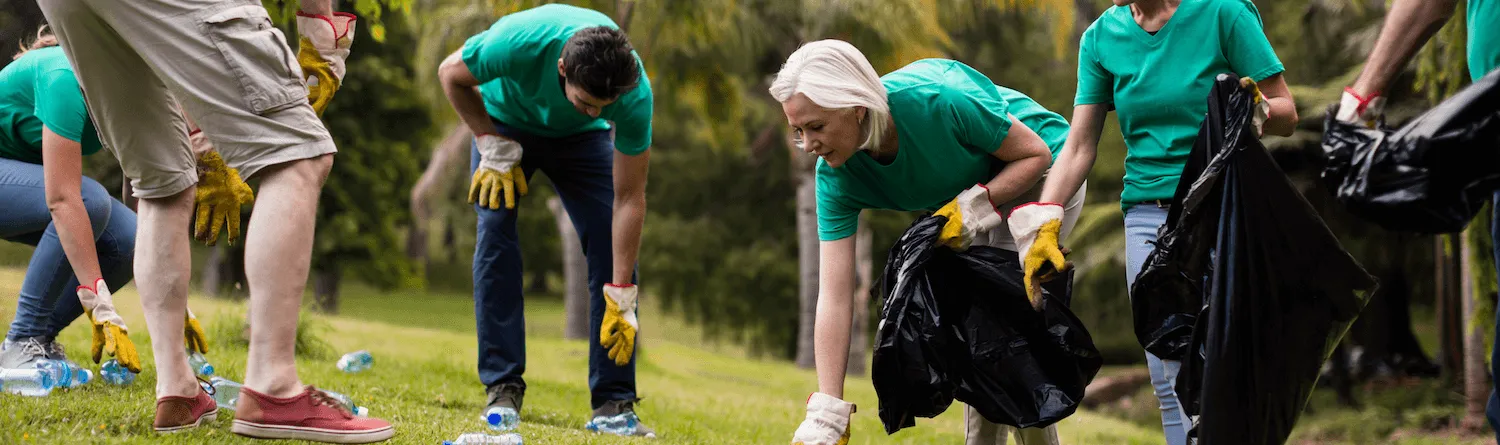
Parks are the single most littered site type in New South Wales. Clean Up Australia's FY25 count across 451 surveyed NSW locations found more litter by site type in parks than on beaches, roadsides, or anywhere else measured. (Clean Up Australia, FY25 NSW Litter Report.) What ends up there, and how it gets from a park bench to a waterway, is a different problem to litter on a street.
What actually ends up in a park
Across NSW's Clean Up Australia sites, parks accounted for 29.3% of litter by site type, ahead of coastal and beach locations at 25.2% and well ahead of roadsides at 8.9%. (Clean Up Australia, FY25 NSW Litter Report.) The item mix reflects how parks get used. Cigarette butts are the single most common item counted statewide at 22.8% of all litter, followed by soft plastic packets and wrappers at 16.8%, plastic bags at 8.5%, takeaway coffee cups at 7.1%, and aluminium beverage cans at 5.5%. (Clean Up Australia, FY25 NSW Litter Report.) Packaging in its various forms, food, beverage and non-food, makes up 62% of everything counted. (Clean Up Australia, FY25 NSW Litter Report.) That composition lines up with what a park is actually for: eating, drinking, smoking and sitting outdoors, rather than passing through, which is more the pattern on a roadside or footpath.
Some of this is improving. Before the NSW Container Deposit Scheme started in 2017, beverage containers made up 28.7% of all litter reported in the state. In FY25 that figure was 14.7%, roughly half. (Clean Up Australia, FY25 NSW Litter Report.) It is the clearest evidence that a scheme aimed at one item category, at scale, genuinely changes what turns up on the ground.
Dog waste is a park problem that bin counts miss
Litter surveys count discarded packaging and containers, but they do not capture dog waste left on the grass, and in a park that is one of the more common problems. Inner West Council estimates that if just one dog's waste were left in the area's streets and parks each day, several tonnes of it would end up in local waterways every year, washed off grass and pavements into the Cooks River, Sydney Harbour and Botany Bay. (Inner West Council.) Once in a waterway it adds nutrients that feed algal blooms and carries bacteria that can cause illness. (Inner West Council.) Good habits start at home, and these tips on managing waste in a pet-friendly home make the daily routine easier.
Under the NSW Companion Animals Act 1998, a dog owner who fails to immediately remove and dispose of their dog's waste in a public place can be fined up to $880. (Inner West Council.) Most councils provide waste bag dispensers in parks, but supply is not guaranteed on every visit, which is the practical reason councils keep telling owners to carry their own bags rather than rely on the dispenser being stocked.
Balloons and party debris: a park problem streets rarely see
Parks host the birthdays, picnics and celebrations that streets do not, and that brings a litter category almost unique to green space: balloons, streamers and party debris. Releasing 20 or more helium balloons together is against the law in NSW, carrying a penalty of up to $1,100, rising to $3,300 if 100 or more are released. (NSW EPA.) The reason is what happens after release. A balloon can take years to break down, and if it ends up in a waterway or the ocean it can be swallowed by marine animals. Sea turtles have been found to selectively eat burst balloons because they resemble their natural prey, jellyfish. (NSW EPA.)
A single dropped party balloon in a park is a different kind of litter event to a cigarette butt or a coffee cup, because it usually starts as one deliberate release rather than something absent-mindedly dropped, and NSW law treats a mass release as an offence in its own right rather than ordinary littering.
Why park litter reaches a waterway faster than street litter does
Litter dropped on a suburban street usually has to survive a longer, drier path before rain moves it anywhere. A lot of park litter does not. Sydney Water notes that stormwater washes litter, sediment, grease and oil from roads and open space into creeks, rivers, the harbour and beaches every time it rains, and the land it manages to control that flow, known as trunk drainage land, typically includes creeks, bushland, or parks and reserves with stormwater pits or channels running directly through them. (Sydney Water.) Sydney Water has installed more than 80 stormwater quality improvement devices across the city, including gross pollutant traps and floating litter traps, to intercept what washes down before it reaches open water; one example is a floating litter trap on the Cooks River at Boat Harbour, Hurlstone Park. (Sydney Water.)
That proximity shows up in the monitoring data. Comparing litter counted on land with litter found in urban estuaries, the NSW Government's Key Littered Items Study found that for every piece of litter counted on land, more than nine times as much turns up washed into an urban estuary, a figure that rises to almost 39 times in the Sydney metropolitan area. (NSW Government, Key Littered Items Study.) A park that backs onto a creek line or sits over a stormwater channel is not a step removed from that waterway the way a street three suburbs inland is.
The difference in one line
Street litter is mostly what falls out of a passing trip, dropped near a gutter that eventually drains somewhere. Park litter is mostly what is left behind after people stop and stay a while, food and drink packaging, cigarette butts, dog waste and, on the right weekend, balloons and party debris, generated closer to the creek lines and drainage channels that many parks are built around. Fixing it means treating it as a different problem, not a smaller version of the same one.
If what you are seeing in a local park looks like repeated dumping rather than everyday litter, that is reported differently to ordinary litter, and the process for doing that is covered on its own page.
Community clean-up days, park working bees and the pile that builds up after a big yard tidy-up all end the same way: more rubbish than a household bin can take. Paul's Rubbish Removal collects household and general rubbish across Sydney, with same-day collection available when booked before midday.