

Household rubbish in Sydney doesn't go through one system. It splits across four things: the red general-waste bin, the yellow recycling bin, the green garden bin (increasingly a food bin too), and a separate free network of drop-off points for anything none of those bins can safely take, batteries, gas bottles, paint, chemicals and e-waste. Get the split right and almost everything you're trying to get rid of has somewhere real to go. Last updated: September 2026.
The numbers that matter
- More than 100 Community Recycling Centres now operate across NSW, free to use for household problem waste.
- A Household Chemical CleanOut event takes up to 20 litres or 20 kilograms of most single chemical items, also free.
- NSW law will require every household with a red-bin service to have a food organics (FOGO) collection by 1 July 2030. 70 councils already run one.
- REDcycle, the old supermarket soft-plastics drop-off, stopped operating in 2022. A narrower authorised replacement now runs through roughly 107 Coles, Woolworths and ALDI stores across NSW and Victoria.
- A typical Sydney council clean-up caps a bulky-item collection at two cubic metres, about the size of a small box trailer.
The Bins, and the One Thing Most Households Are Missing
Red lid, general waste. Everything that isn't recyclable, compostable or a problem waste goes here: broken crockery, soft plastics, nappies, textiles, vacuum dust, and anything the other three streams explicitly reject. It's the default, not the right answer for most of what actually goes in it.
Yellow lid, recycling. Hard plastics, glass bottles and jars, paper, cardboard, aluminium and steel cans, loose and rinsed, never bagged. Exactly what counts, and where councils quietly disagree with each other on lids and pizza boxes, is its own detailed question. See our full yellow bin guide rather than guessing.
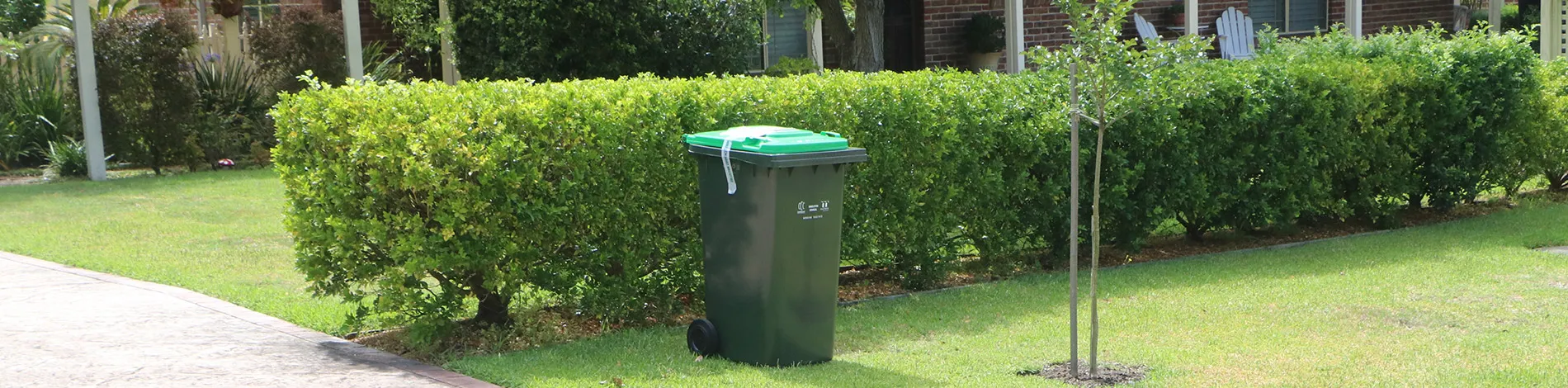
Green lid, garden organics, and increasingly food too. Garden waste has always gone here. Food organics is the newer part: NSW has now legislated it, every household on a red-bin service gets a Food Organics and Garden Organics (FOGO) collection by 1 July 2030, and 70 councils already run one. Where FOGO has landed, food scraps, meat, bones and all, go in the green bin using a compostable caddy liner that meets Australian Standard AS 4736-2006. Home-compostable liners don't qualify, and neither do "compostable" coffee cups, pizza boxes or baking paper. That's the detail people get wrong most often: a liner marked compostable at the supermarket isn't automatically the right one for the council caddy.
The fourth thing: the kitchen caddy. If your council has rolled out FOGO, the caddy on your bench is doing real work, not a gimmick. It's what makes the food-scraps stream possible without a fourth wheelie bin at the kerb. If your council hasn't rolled it out yet, food scraps go in the red bin until it does, not the green one, mixing food into garden organics before your council is set up for it contaminates the load the same way the wrong plastic contaminates a yellow bin.
What Must Never Go in Any Bin, Any Colour
A short list causes most of the damage, and it's the same list, whatever colour bin someone tries to use.
Batteries. Loose batteries and butane canisters can cause fires in collection trucks, and that's true whichever bin they end up in. Batteries, including the ones built into vapes, e-toothbrushes and kids' toys, should never go in a kerbside bin at all. Loose household batteries go to a B-cycle drop-off point; batteries built into a device go to a Community Recycling Centre instead.
Gas cylinders. Empty or not, a gas bottle isn't kerbside material. It's one of the standard items a Community Recycling Centre takes free of charge, where undamaged bottles are retested and re-entered into the hire industry rather than scrapped.
Paint and chemicals. Paint, solvents, pool chemicals, pesticides and motor oil all belong to the same problem-waste category as gas bottles and batteries. A Community Recycling Centre takes most of them year-round; a Household Chemical CleanOut event takes the same list plus a few extras (poisons, acids and alkalis, hobby chemicals) up to 20 litres or 20 kilograms per item, with up to 100 litres of paint accepted at some events.
E-waste. A television, computer or printer is covered by a national scheme, not your council's kerbside truck: drop it at a designated collection point, a take-back event, or send it back by mail. If it still works, a second-hand shop, a charity or a family member is a better first stop than recycling it at all.
Sharps. Needles, syringes and lancets should never go in a household or street bin, full stop, even inside a container. At home, keep them in a rigid, puncture-proof container with a screw-top lid, an empty laundry detergent bottle works, never a glass jar, cardboard box or drink bottle. Community sharps bins sit at some pharmacies, medical centres, community health centres and council-provided points in public toilets and parks; if a container is too big for one of those, a pharmacy, medical centre or hospital can usually take it directly.
Bulky Items: What a Council Clean-Up Actually Covers
Every Sydney council runs some version of a booked bulky-item collection, and the mechanics are similar enough to describe generally, with the caveat that limits and categories are set locally. Inner West Council's system is a representative example: residents book online by category, four in that case (bulky household items and furniture, branches, metal and whitegoods, mattresses), because different trucks collect different waste types, and a wrong category means the items simply aren't picked up.
The cap that catches people out is volume, not item count. A typical limit is two cubic metres per collection, roughly the size of a small box trailer, and going over it doesn't mean partial collection, it means none of it gets collected until it's re-booked and often re-charged. The same booking excludes the things covered above: paint, oils, gas cylinders, batteries, fluorescent tubes and smoke alarms are explicitly routed to a Community Recycling Centre instead, alongside building materials, asbestos and anything too heavy for two people to lift.
For what an actual Sydney tip or transfer station charges by weight or by trailer load, and how a DIY dump run compares to booking a service, see our Sydney rubbish dump guide.
Hazardous Household Waste Is a Different System Entirely, and It's Free
Two networks exist specifically because none of the four bins above can safely carry this material: Community Recycling Centres, permanent drop-off sites open year-round, and Household Chemical CleanOut events, mobile drive-thru days held at rotating locations. Both are free for households, both cap most single items at 20 litres or 20 kilograms, and between them they cover paint, gas bottles, household and car batteries, motor and cooking oils, fluorescent tubes, smoke detectors, fire extinguishers, pesticides, pool chemicals, solvents and vapes. Businesses aren't eligible for either; commercial quantities go through a commercial waste operator instead. For safety, CleanOut staff collect items from your vehicle, so you don't unload chemicals by hand and containers aren't handed back.
The Things With Their Own Scheme
A handful of items have a dedicated national or industry system that exists precisely because kerbside bins and even Community Recycling Centres aren't the full answer.
Batteries split two ways depending on what they're in. Loose household batteries, AA, AAA, button, rechargeable and power banks, go to a B-cycle drop-off point, part of Australia's official battery stewardship scheme. Vapes don't qualify there and need a Household Chemical CleanOut event instead, since a vape's battery is embedded and it also carries residual chemicals.
TVs and computers move through the National Television and Computer Recycling Scheme: designated drop-off points, take-back events, or mail-back, rather than kerbside collection.
Mobile phones have their own free industry-funded scheme, MobileMuster, funded by the telecommunications sector rather than government, with drop-off points including select telco stores.
Soft plastics are the scheme most people still get wrong. REDcycle, the old supermarket drop-off bin, stopped operating in 2022. A narrower, ACCC-authorised replacement now runs through a limited group of roughly 107 Coles, Woolworths and ALDI stores across NSW and Victoria, so check with your specific store before assuming the old scheme is back everywhere it used to be. Soft plastics have never belonged in a yellow bin, before or after REDcycle, because they jam sorting machinery.
If Sorting Five Systems Isn't Realistic Right Now
Working out which of these systems a given item belongs to is exactly the kind of job that eats an afternoon, especially clearing out a whole house or garage where the pile is general waste, recyclables, e-waste and problem waste all mixed together. Paul's Rubbish Removal collects the lot in one go and takes it to council processing facilities that recycle, so the sorting isn't something you have to do before you can call. See our household rubbish removal service, or call 0407 125 125 for a free quote.