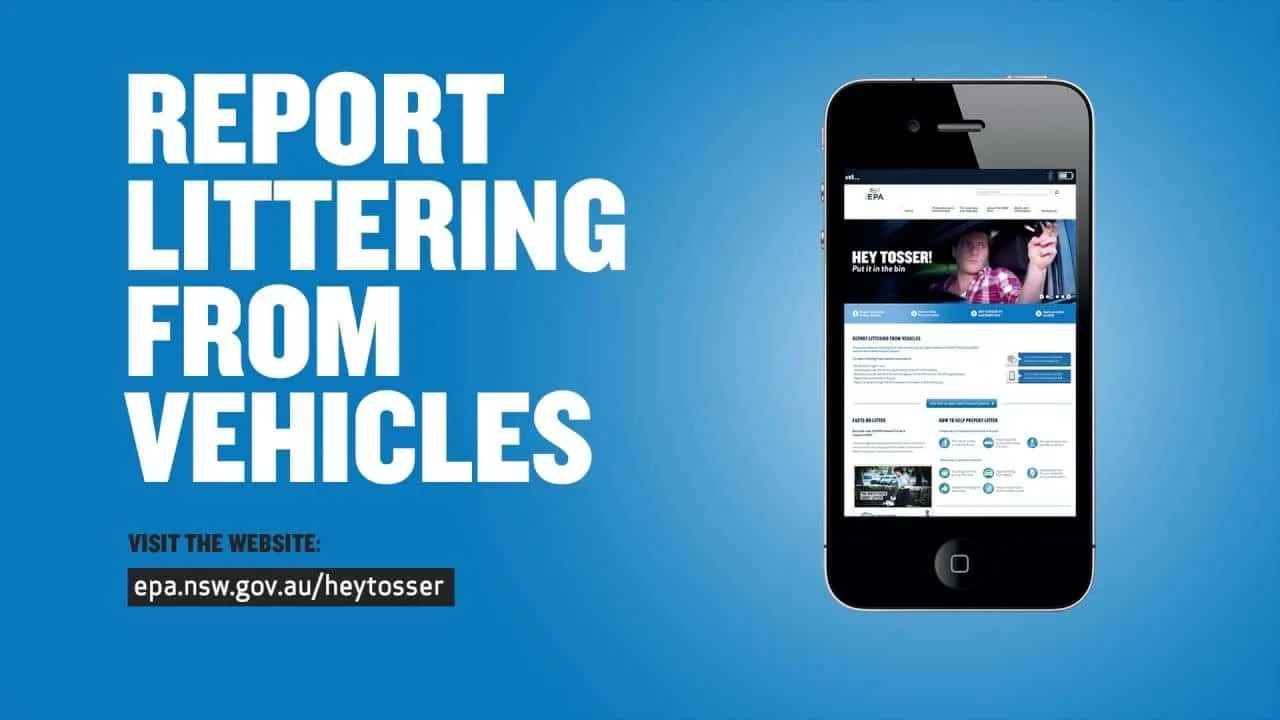
To report littering in NSW, use Report to EPA online, or call Environment Line on 131 555 for general enquiries. Littering from a vehicle carries an on-the-spot fine of $500 for an individual-owned vehicle or $1,000 for a corporation-owned one, issued to the registered owner, and must be reported online within 14 days of seeing it happen. Last updated: September 2026.
Litter is a bigger problem than one dropped wrapper
Cigarette butts are the most-littered item in NSW. The EPA estimates around 1.32 billion are littered across the state every year, and its most recent Butt Litter Index found 56% of smokers observed at monitored sites still dropped their butt rather than binning it. A 2018 trial across 40 sites with 16 councils showed how fixable that is: targeted binning strategies lifted binning rates from 38% to as high as 76% at the best-performing sites.
"Report a Tosser!" is still the name, but the campaign around it has changed
If you remember "Don't be a Tosser!", that's the older branding. The NSW EPA's public litter campaign has been rebranded Nature Hates a Tosser, and now runs with a magpie and a green sea turtle rather than the old imagery. Report a Tosser! is still current: it's the name of the specific scheme for reporting littering from a vehicle, now sitting inside the Nature Hates a Tosser campaign rather than under the retired "Don't be a Tosser!" name.
How to report littering from a vehicle
- See it happen. You need to have actually seen the litter being thrown, dropped or blown from the vehicle, including off an uncovered load such as a ute tray or trailer. Litter you find near a parked, empty car doesn't qualify.
- Note the vehicle and the location. You'll need the registration number, the vehicle's make, body type and colour (model too, if you can), plus the street, suburb, nearest cross street, and the date and time.
- Register with Report to EPA, if this is your first report. You'll need a mobile phone to receive an SMS verification code. No mobile, or under 18? You register offline instead, with a certified copy of photo ID.
- Submit online within 14 days of seeing it happen. Reports can only be made through Report to EPA online, or on your mobile, never by phone, email or fax.
- Keep your evidence for a year. Photos or video aren't compulsory, but if it's safe to take them, they help. Keep whatever notes, photos or recordings you have in case the fine is disputed and you're needed as a witness.
Never use your phone while driving. If you're behind the wheel, pull over first or ask a passenger to record the details. The EPA can't use evidence collected illegally, and your safety matters more than the report.
Who actually gets fined
The fine goes to the registered owner of the vehicle, not automatically the person who littered. Under the Protection of the Environment Operations Act 1997, the owner is deemed liable unless they lodge a statutory declaration naming the person actually responsible, such as a passenger or someone else who was driving at the time.
What the fine actually is
Littering fines increased in recent years, and older articles quoting $200 for an individual are out of date. The current on-the-spot penalties under the POEO Act:
- Small item or unlit cigarette: $160 individual, $160 corporation. Maximum penalty $5,000 (individual) / $10,000 (corporation).
- Other litter, or litter from a vehicle: $500 individual, $1,000 corporation. Maximum penalty $5,000 (individual) / $10,000 (corporation).
- Dangerous material (e.g. a lit cigarette): $1,000 individual, $5,000 corporation. Maximum penalty $25,000 (individual) / $50,000 (corporation).
- More than 50 litres or 50kg: $1,000 individual, $5,000 corporation. Maximum penalty $25,000 (individual) / $50,000 (corporation).
- More than 50L or 50kg, in a sensitive area: $2,500 individual, $10,000 corporation. Maximum penalty $50,000 (individual) / $100,000 (corporation).
"Dangerous material" specifically covers a lit cigarette or butt, an e-cigarette, a lithium battery, a syringe, glass, and oil, fuel, grease, paint or solvent. All of these are treated more seriously than ordinary litter because of the extra fire or safety risk.
The fine doesn't go up if the same person is reported more than once, and it doesn't increase during fire season under the POEO Act. The Rural Fire Service does run its own separate penalties for cigarette butts during Total Fire Bans, on 02 8741 5555.
What happens after you submit a report
The EPA checks the vehicle details you provide against Roads and Maritime Services records, along with at least 18 other mandatory details in your report, which takes 1–3 days. If everything checks out, a penalty notice goes to the registered owner. From there, they can pay it, nominate the actual offender to Revenue NSW by statutory declaration, request a review, or elect to have the matter heard in court.
Only around 2% of people who get a littering fine choose to go to court. If that happens with a report you made, you may be asked for a written statement or to appear as a witness, which is why it's worth holding onto your notes and any photos for the full year rather than deleting them once the report is submitted.
Reporting litter that isn't from a vehicle
Not every littering report is a vehicle report. Someone dropping litter on foot, in a park, or general rubbish dumped on a local road is usually a matter for your local council, not Report to EPA. Roadside rubbish on a major road or highway goes to Transport for NSW on 131 700. Discarded newspapers and flyers from a delivery run are also a council matter, since there's a specific exemption for newspaper delivery in the litter laws, so Report to EPA won't take that one.
For anything else, including questions about how the reporting process works, Environment Line takes calls on 131 555 or email at info@epa.nsw.gov.au. It's staffed 24/7 for pollution reports the EPA directly regulates and for noisy or smoky vehicle reports; general enquiries run 8:30am to 5pm on weekdays. Environment Line can talk you through the process, but it can't lodge a vehicle littering report on your behalf; that only happens through Report to EPA itself.
Reporting an interstate vehicle
If the vehicle is registered in Victoria, Queensland or the ACT, the EPA can still act on your report, provided the littering itself happened in NSW. Vehicles registered in Western Australia, South Australia, the Northern Territory or Tasmania can't be actioned through this scheme.
Reporting a tosser deals with someone else's mess on the road. If it's your own build-up you're trying to shift instead (old furniture, general household junk, whatever's been piling up in the garage), Paul's Rubbish Removal collects it with a free, no-obligation quote. See household rubbish removal for how it works.