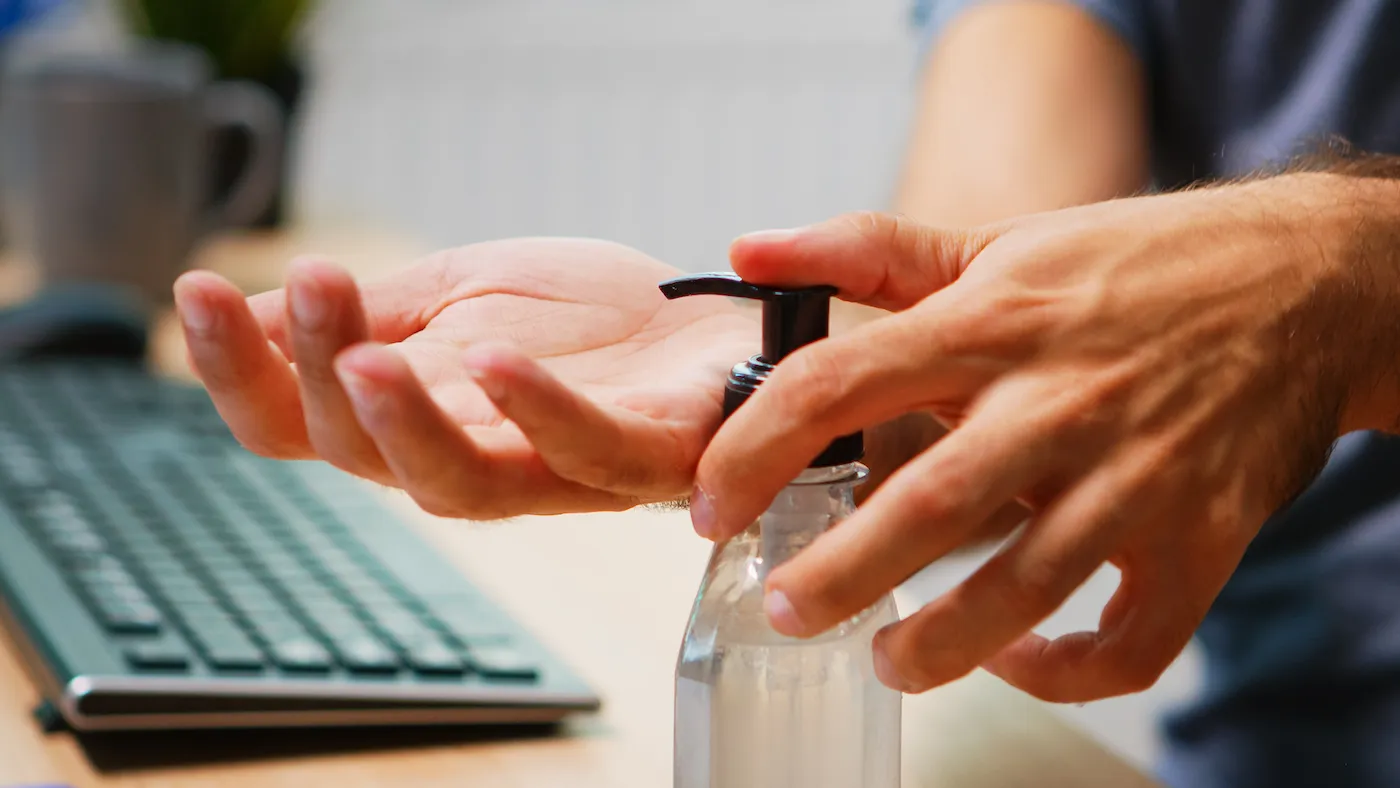
An empty hand sanitiser bottle is rigid plastic, so it usually goes straight in your kerbside recycling bin. Leftover or expired sanitiser is different: don't pour it down the drain. Use it up if you can, or take it to your council's chemical disposal option. In Sydney, that's the free NSW Household Chemical CleanOut.
Last updated: August 2026.
Is Hand Sanitiser Actually Hazardous Waste?
Most hand sanitiser is alcohol-based, typically at least 60% alcohol by volume, and the US EPA classifies it as an ignitable hazardous waste once it's thrown out. The 60% figure isn't just a US waste-classification threshold either: Australia's own regulator, the Therapeutic Goods Administration, says hand sanitiser needs at least 60% alcohol just to be effective at killing germs in the first place, and products marketed as following the World Health Organization formula carry even more again, 80% ethanol or 75% isopropyl alcohol. That's also the reason not to tip it down a drain: alcohol vapour trapped in pipes and sewer lines can cause fires and explosions, not just an environmental problem. A flammable liquid's classification comes down to its flash point, the temperature at which it will ignite, and low-boiling-point liquids like alcohol tend to produce more of the vapour that catches fire in the first place. The empty bottle itself isn't hazardous. Once it's completely empty, it's just rigid plastic.
How to Dispose of an Empty Hand Sanitiser Bottle
Once it's completely empty, a hand sanitiser bottle is rigid plastic and can usually go straight in your kerbside recycling bin. If it has a pump or spray nozzle, take that off first: nozzles often contain mixed materials that can't be recycled kerbside, so they go in general waste instead.
How to Dispose of Leftover or Expired Hand Sanitiser
If there's still liquid in the bottle, don't pour it down the sink. Use it up if you can, or take it to your council's chemical disposal option.
It shouldn't go in the general rubbish bin either. City of Sydney warns that household chemicals put in the general (red lid) bin can spontaneously combust or leak into soil and pollute groundwater. That's not a hand-sanitiser-specific warning, but the same logic applies to any leftover flammable chemical, sanitiser included.
In Sydney, that option is the NSW Household Chemical CleanOut: a free, drive-thru event held across NSW on specified dates. You stay in your vehicle and staff collect what you've brought. Hand sanitiser isn't named individually on the accepted-items list, but it's the same kind of household chemical the programme exists for. Check with the event or your council if you're unsure.
For the full accepted-items list, quantity limits and what else CleanOut will and won't take, see our hazardous waste disposal guide.
Community Recycling Centres: A Year-Round Alternative to CleanOut
If you don't want to wait for the next CleanOut event, NSW also has a permanent option. Community Recycling Centres (CRCs) are free, year-round drop-off points for household problem wastes that can't go in your kerbside bins, and there are more than 100 of them across NSW. Most are open to any NSW resident, not just people who live in that council area, though a small number of centres are the exception. The same household-quantity rule applies as CleanOut: up to 20 litres or 20 kilograms of a single item. Hand sanitiser isn't named on the standard CRC accepted-items list either, but some centres take items beyond that list, so it's worth checking with your local centre first, and whether any charges apply. Like CleanOut, CRCs are for household quantities only. Businesses aren't eligible and need to arrange a commercial waste service instead. Since the CleanOut programme began in 2009, NSW residents have safely disposed of more than 340 tonnes of household chemicals through it.
How to Safely Transport Leftover Sanitiser to a Drop-off Point
Whether you're headed to a CleanOut event or a CRC, handle and transport it carefully. Keep it in its original, clearly labelled container where possible, and never mix it with other chemicals, mixing chemicals can cause dangerous reactions. Because it's a liquid, wrap the container securely in newspaper, then place it in a sturdy plastic bag and a plastic bucket or tray in case it leaks. Keep it out of the cabin, in the boot of your car and away from passengers, ideally on a protective sheet or tray to catch any spills.
Hand Sanitiser Disposal at Work or in an Office
The same two rules apply at work: recycle the empty bottles, and don't tip any leftover liquid down a sink.
Safe Work Australia's own guidance for businesses is blunt about what to do with flammable liquids you don't need: dispose of them, in line with your local waste disposal requirements, because eliminating a hazard altogether is the most effective way to stop an incident before it starts. An old or half-used bottle of hand sanitiser sitting in a cupboard is exactly that kind of unnecessary flammable liquid, and the same guidance says to limit how much you keep on hand in the first place, buying only what you actually need.
While it's sitting in a cupboard or stockroom waiting to be dropped off, treat it like any other flammable liquid. Alcohol-based products are one of the flammable liquid types covered by Safe Work Australia's storage guidance for businesses, and that guidance is written for businesses storing small quantities, not just big industrial ones. Flammable liquids are a common source of fires and explosions because they produce vapour that ignites at low temperatures, and fires often start when a container is spilt or left open near an ignition source such as a flame, a heater, or even a hot light bulb. Businesses have a duty to manage that risk and to keep flammable liquids at the lowest practicable quantity for the workplace. In practice, that means keeping bottles away from ignition sources such as pilot lights, heaters or open flames, not leaving lids off any longer than needed, and cleaning up any spills straight away. If your business is storing a genuine stockpile rather than a few bottles at reception, it's also worth keeping it separated from other chemicals rather than shelved together, and putting up a sign warning people not to bring ignition sources near it.
The NSW Household Chemical CleanOut is built for household quantities, up to 20 litres or 20 kilograms of a single item. Business or commercial quantities of chemicals aren't accepted at all. If you're only clearing a handful of bottles from a shared office, that's a different scale to a genuine bulk workplace clear-out, check with the event or your council if you're not sure which side of that line you're on. For a real business-quantity clear-out, contact a commercial waste operator instead.
Frequently Asked Questions
Can you pour hand sanitiser down the sink?
No. Alcohol vapour trapped in pipes and sewer lines can cause fires and explosions, not just an environmental problem. Use it up or take it to a chemical disposal option instead.
Can hand sanitiser bottles be recycled?
Yes, once they're completely empty. The bottle is rigid plastic and usually goes in kerbside recycling, take off any pump or spray nozzle first and put that in general waste.
Is hand sanitiser hazardous waste?
Most hand sanitiser is alcohol-based, typically at least 60% alcohol by volume, which is why the US EPA classifies it as an ignitable hazardous waste once it's thrown out. In Sydney, leftover or expired sanitiser is the kind of household chemical the free NSW Household Chemical CleanOut exists for.
Can I put leftover hand sanitiser in the general rubbish bin?
No. The same reasoning that applies to other household chemicals applies here: chemicals discarded in general rubbish can spontaneously combust or leak into soil and pollute groundwater. Use it up, or take it to a CleanOut event or your nearest Community Recycling Centre instead.
Is there somewhere I can drop off hand sanitiser without waiting for a CleanOut event?
Yes. NSW Community Recycling Centres are free, permanent drop-off points open year-round, unlike CleanOut, which only runs on specified dates.
Is it dangerous to keep a bottle of leftover sanitiser around until I can drop it off?
Not if it's a small household amount kept in a reasonably ventilated spot. Safe Work Australia's guidance notes that flammable liquids stored in small quantities generally shouldn't create a hazardous atmosphere as long as there's adequate ventilation, just keep the lid on and keep it away from anything that could ignite it.
Does Paul's Rubbish Removal collect hand sanitiser or other hazardous waste?
Yes. Paul's Rubbish Removal handles hazardous waste, leftover sanitiser included. The free NSW Household Chemical CleanOut is the alternative if you'd rather drop it off yourself. Either way, Paul's can take the general rubbish from the same clear-out.
Sanitiser sorted, or still sitting there with the rest of a clear-out, old furniture, boxes, general junk? Paul's Rubbish Removal can take the lot in one visit. Call 0407 125 125 for a free, no-obligation quote.
Full details on CleanOut dates, locations and what else you can bring: Household Chemical CleanOut in Sydney.